
Mostafa Amin Failed 4 Times Before Breadfast. That's Not a Backstory. That's the Point.

Mostafa Amin Failed 4 Times Before Breadfast. That’s Not a Backstory. That’s the Point.

Breadfast Series | Article 2 of 18.

Everyone wants to understand the Breadfast model. Fewer people want to understand the Mostafa Amin model.

In 2016, Egypt was in crisis after the pound float and devaluation. The rational move for an ambitious, technically capable Egyptian founder — biomedical engineering degree, Forbes 30 Under 30, co-built Egyptian Streets — was to leave. But he stayed.

And he stayed after four failed startups. Not pivots. Not ‘learnings.’ Failures.

That detail matters more than any metric in the Breadfast cap table.

The decision that defined everything

When Breadfast launched, the obvious model was to aggregate. Build an Uber for bread, connect consumers to nearby bakeries, handle the app layer, take a cut. Asset-light, fast to build, easy to pitch. It’s the model that would have made sense to any investor in 2017.

Mostafa said no.

“Building a grocery marketplace alone wouldn’t work. Owning the supply chain was necessary because the margins are thin, and reliability in emerging markets is key.”

That decision to own the bakeries, own the fulfillment centers, own the last mile, from day one, was the most consequential and least celebrated choice in Breadfast’s history. It required more capital, more operations, more complexity. It looked nothing like the lean startup playbook. But it was the correct answer for Egypt. And Mostafa knew it because he had watched Egypt’s third-party supply chains fail, up close, for years.

This is the founder insight that cannot be taught in an accelerator program: the ability to look at a global template, understand why it doesn’t work locally, and build something harder, uglier, and more defensible instead.

Mostafa also drove the first delivery himself

This is not a trivia point. It is a signal about founder psychology.

The CEO of what is now a reportedly valued $400M+ company personally drove bread to customers in Cairo because he needed to understand the operation at its most granular level before he could design it at scale. That hyper-local, operations-first mentality helps explain why Breadfast’s GMV retention exceeds 100% after 20 months. Customer experience was not a KPI; it was a lived practice before it was a metric.

Contrast this with a common founder pattern: build the deck, raise the round, hire the team, optimize from the top. Breadfast was built from the delivery route up.

Staying in Egypt was itself a strategic bet

There’s a pattern in the Egyptian ecosystem that rarely gets discussed publicly: founders who build in Egypt, raise internationally, and quietly shift their operational center of gravity to the UAE, Saudi, or beyond. The reasoning is understandable. Dollar revenues, easier banking, investor proximity, talent retention.

Mostafa stayed. The company stayed. And the hyper-local depth of knowledge that came from staying, understanding Cairo neighborhoods, knowing which products resonate in Mansoura versus Alexandria, understanding how Egyptian households shop, became a hard-to-replicate moat.

You cannot outsource that knowledge. You cannot acquire it in a due diligence call. It is accumulated, slowly, by people who are embedded in the market they serve.

What the Breadfast founder story is really about

It is not a story about a brilliant idea. Bread delivery is not a brilliant idea. It is a story about a founder who was willing to do the hard, capital-intensive, operationally complex thing that nobody else wanted to do, in a market many investors and operators viewed as too volatile

Four failed companies. A currency crisis. The ‘wrong’ business model by Silicon Valley standards. A $400M company built on fresh bread and a supply chain that runs in the dark.

For every founder in Egypt: the lesson is not to copy the Breadfast model. The lesson is to deeply understand your market, make the decision that is correct for that market even if it contradicts global playbooks, and be willing to be the first driver. The ecosystem doesn’t need more people with good ideas. It needs more people willing to own the supply chain.

Breadfast’s founding story is replicable. The specific decisions Mostafa Amin made; owning the supply chain, staying in Egypt, driving the first delivery himself, are available to every founder in this market right now.

My challenge: if you are building in Egypt today, what is the equivalent of ‘driving the first delivery yourself’ in your business? What is the hard, unglamorous decision that your competitors are avoiding, and that you are willing to own? Answer that in the comments. The most honest answers will be the most useful ones.

References

Missed Article 1? Read it here: The Deal: What Breadfast’s $50M Round Actually Signals

The Deal What Breadfast's $50M Round Actually Signals

The Deal: What Breadfast’s $50M Round Actually Signals
Breadfast Series | Article 1 of 18.

The headline is interesting. The structure underneath it is extraordinary.

Breadfast just closed $50M in a pre-Series C round. The investors: Mubadala Investment Company ($330B AUM, Abu Dhabi), IFC — International Finance Corporation (World Bank), EBRD (European development bank), Olayan Financing Company (Saudi), SBI Investment (Japan), a Saudi billionaire family office, Y Combinator, Novastar Ventures, 4DX Ventures, and AAIC Investment. The company is valued at $400M+. A larger Series C is expected in H1 2026.

What the cap table says that the press release doesn’t

The investor mix in this round is not accidental. It is deliberate architecture.

Mubadala is strategic capital. When Abu Dhabi’s sovereign wealth fund invests in an Egyptian consumer platform, it is not making a portfolio diversification decision. It is making a geopolitical one; building a digital-infrastructure position in a country where the UAE has already committed $35 billion in physical infrastructure (Ras El Hekma, February 2024). Mubadala follows UAE strategic interest. This investment signals that Breadfast’s household reach and data moat are considered strategic assets, not just financial ones.

IFC and EBRD are the quality stamp. Development Finance Institutions move slowly and require the highest standards of governance, financial reporting, and impact documentation. Their dual presence in this round sends a specific signal to commercial investors: this company has passed institutional-grade due diligence. That stamp made Mubadala, Olayan, and SBI comfortable moving at this pace.

Olayan and the Saudi family office are the Gulf consumer bet. Saudi capital has been increasing strategic exposure to Egypt since 2022; PIF $5B, multiple real estate and infrastructure deals. A consumer platform with 500,000 Egyptian households is exactly the kind of asset a Gulf family with FMCG and retail exposure wants to own quietly before an IPO re-rates the valuation.

SBI is the fintech signal. Japan’s SBI is not a grocery investor. It is a fintech infrastructure investor. Its presence in this round is most likely about Breadfast Pay; the financial services layer that makes this company something dramatically different from a delivery platform.

The business metrics that made all of this possible

500,000+ monthly active customers. 47 fulfillment centers. 8,000+ SKUs. $150M+ ARR. 100%+ GMV dollar retention after 20 months. 40% private label penetration. These are not impressive numbers for an Egyptian startup. They are impressive numbers for a company, full stop.

The 100%+ GMV dollar retention in particular deserves attention. This means that cohorts of Breadfast customers spend more on the platform in dollar terms 20 months after joining than they did when they joined, during a period of 70% currency devaluation and 38% peak inflation. That is extraordinary customer behavior. It means the product is not a convenience; it is a necessity.

The ‘pre-Series C’ label is doing significant work

Breadfast could have called this a Series C. By metrics, it qualifies. They chose not to, and the choice is deliberate. Calling it a pre-Series C signals to the market that a larger round is coming; with growth investors at a higher valuation. The $50M round creates FOMO. It establishes a price anchor. It demonstrates that institutional, sovereign, and development capital have all agreed on $400M+ as the floor. The Series C, expected H1 2026, will be negotiated from a position of significant strength.

What the proceeds will actually fund

Three things: infrastructure expansion (warehouses, fulfillment centers, production facilities), Africa market entry (North and West Africa explicitly mentioned), and the adjacent verticals; private label production at scale, omnichannel retail, and Breadfast Pay’s embedded financial services build-out. Each of these is not just an operational line item. Each is a separate business thesis.

The number nobody is talking about: 3%

Breadfast is targeting 3% of Egypt’s $100 billion grocery market within three years. That is $3 billion in GMV. At current penetration levels, achieving 3% requires roughly 6x the current customer base, from 500,000 monthly active customers to approximately 3 million. It requires the Africa expansion to provide additional revenue base for the IPO valuation narrative. And it requires Breadfast Pay to be commercially significant, not just a feature.

That is an enormous amount of execution. The $50M buys the runway to attempt it. The Series C will fund the attempt at scale.

My read: This is Egypt’s most strategically significant startup fundraise since MNT-Halan’s unicorn round. Not because of the number; because of who is in the room, why they’re there, and what it signals about the trajectory of the company and the country. The 15-post series that follows unpacks every layer of this.

The deal is now public. The analysis should be too.

Every number in Breadfast’s cap table represents a different investor thesis about Egypt’s future, and most of those theses have not been written down clearly anywhere. I’ve spent this article trying to make them explicit.

My challenge to every investor, founder, and ecosystem builder reading this: which of these investor theses do you believe most strongly and which do you think the market is getting wrong? Drop your view in the comments. The most interesting conversations in the Egyptian ecosystem right now are happening in comments sections, not in boardrooms.

References

A graph displaying various countries and regions represented by differently colored squares, illustrating AI venture capital funding in the MENA region from 2022 to 2024, with UAE showing the highest percentage. The graph includes data for Egypt, KSA, Qatar, and Jordan.

نظرة واقعية إلى الاستثمار في الذكاء الاصطناعي في منطقة الشرق الأوسط وشمال أفريقيا.

كانت واحدة من كل خمس صفقات استثمار جريء في المنطقة خلال عام 2024 موجّهة لشركات تعمل في الذكاء الاصطناعي، لكن الأرقام تروي قصة مختلفة.

بين عامي 2022 و2024، حصلت 322 صفقة في مجال الذكاء الاصطناعي على تمويل إجمالي قدره 660 مليون دولار. وفي مايو 2025، ورغم زيارات كبار التنفيذيين من شركات التكنولوجيا الأمريكية، لم تجمع الشركات الناشئة في الذكاء الاصطناعي سوى 25 مليون دولار من صفقتين فقط.

الواقع أن السرد الإعلامي والتدفقات التمويلية منفصلان عن بعضهما. فقد أعلنت صناديق الثروة السيادية عن مليارات مخصّصة للبنية التحتية للذكاء الاصطناعي، لكن التدفق الفعلي نحو الشركات الناشئة ما يزال محدودًا.

مبادرات مثل GAIA Accelerator في السعودية بقيمة مليار دولار، واستثمار الإمارات 6.6 مليار دولار في OpenAI، تعكس التزامًا طويل الأمد. لكن الشركات في المراحل المبكرة ما تزال تكافح لإثبات عائدٍ فعلي يتجاوز العقود التجريبية.

يستحوذ الذكاء الاصطناعي في التقنية المالية على نحو 26٪ من إجمالي التمويل، ويذهب معظم ذلك إلى اكتشاف الاحتيال وتقييم الجدارة الائتمانية. أما برمجيات الذكاء الاصطناعي المؤسسي فتحظى باهتمام، لكنها ما تزال تفتقر إلى صفقات خروج تثبت سلامة تقييماتها.

المستثمرون اليوم يريدون برهانًا عمليًا على جدوى الفكرة، لا عروضًا تقديمية. والشركات التي تحل مشكلات حقيقية في قطاعات منظّمة، مثل معالجة اللغة العربية للخدمات الحكومية أو التحليل التنبؤي لسلاسل الإمداد، هي التي ستجذب التمويل قبل المنصات العامة.

لذلك، على كل شركة ذكاء اصطناعي أن تركّز على حالات استخدام محددة ذات عائد واضح، وأن تستهدف قطاعات تملك ميزانيات للامتثال، وأن تبدأ التوسع عندما يدفع العملاء، لا مقابل التقنية ذاتها، بل مقابل النتائج الفعلية.

تمويل الذكاء الاصطناعي في منطقة الشرق الأوسط وشمال أفريقيا يشهد تراجعًا. لكن في الوقت نفسه، ارتفع إجمالي تمويل الشركات الناشئة خلال أبريل ومايو لأن الجولات غير المرتبطة بالذكاء الاصطناعي (التقنية المالية، والخدمات اللوجستية، ومنصات الأسواق، والرهانات القريبة من البنية التحتية) هي التي حملت الشهر، عبر عدد قليل من الصفقات الكبيرة، إلى جانب عدد كبير من الصفقات الصغيرة، بما يمثل زيادة شهرية قدرها 105%، ونحو 300% مقارنة بأبريل 2024، وفقًا لـ Lucidity Insights. هذا انتقال في اهتمام المستثمرين بين القطاعات، لا موجة صاعدة للذكاء الاصطناعي. والرسالة التي يقولها المال واضحة: “سننفق حيث تكون النتائج قابلة للقياس اليوم”.
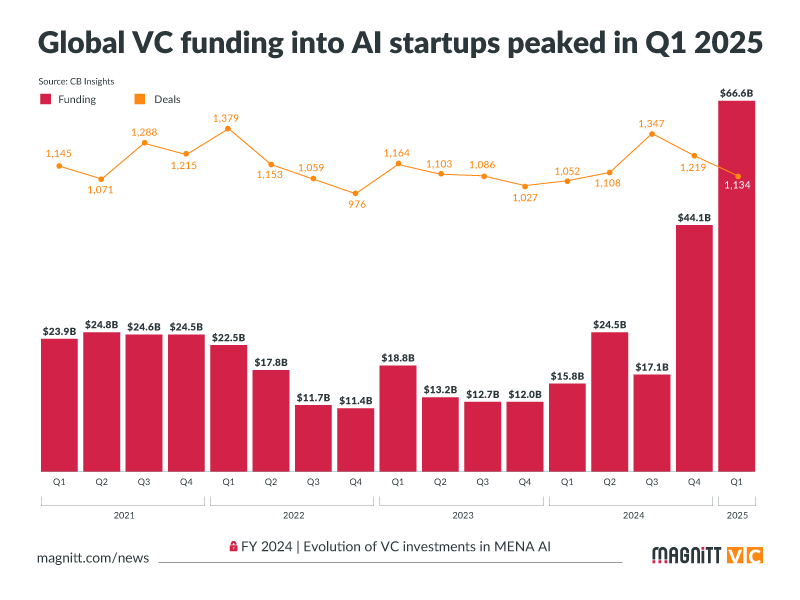
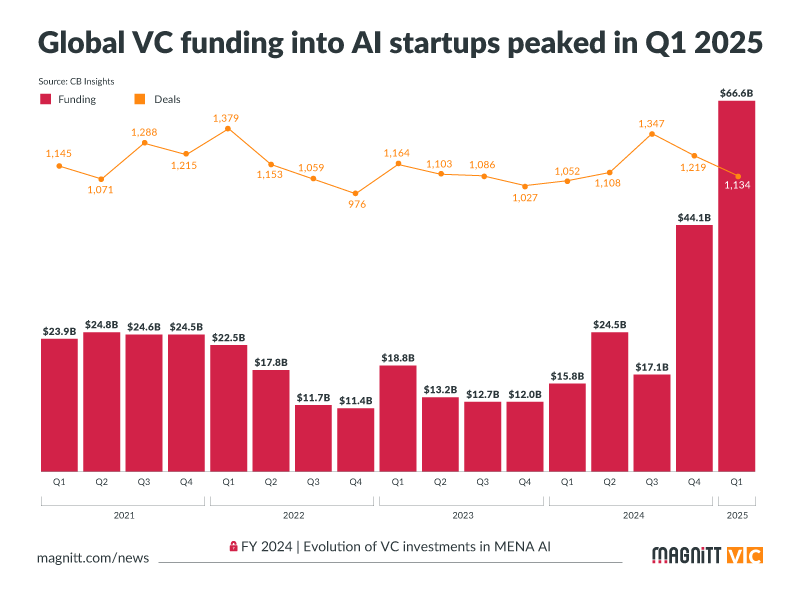
ويحدث كل ذلك بينما التدفق العالمي يعمل بكامل قوته؛ فقد بلغ تمويل رأس المال الجريء للذكاء الاصطناعي في الربع الأول من 2025 نحو 66.6 مليار دولار، وفقًا لـ MAGNiTT، وهو أعلى مستوى فصلي على الإطلاق، مع ارتفاع طفيف فقط في عدد الصفقات، ما يعني شيكات أكبر وعودة الجولات المتأخرة.
وبعبارة مباشرة: الأموال عالميًا تعود لمطاردة الذكاء الاصطناعي على نطاق واسع. ولهذا يصبح التباين مع منطقة الشرق الأوسط وشمال أفريقيا مهمًا: المدّ العالمي يرتفع، لكن الشيكات المحلية الموجهة للذكاء الاصطناعي لا تزال انتقائية. وإذا كنت مؤسس شركة ذكاء اصطناعي في المنطقة، فالمعيار هو أن تُظهر إيرادات واضحة وعائدًا على الاستثمار يمكن تكراره، لكي تتمكن من الالتحاق بموجة رأس المال العالمية هذه.

المراجع:

More Rebrands Than Newbies: Unpacking MENA AI Growth in 2025
https://lucidityinsights.com/infobytes/mena-ai-startups-rebrand-trends-2025

FY 2024 Evolution of AI in MENA
https://magnitt.com/research/evolution-of-ai-in-mena-2022-2024-50993

Billions in Play: Inside 9 MENA AI Initiatives
https://magnitt.com/news/billions-in-play-inside-the-mena-s-bold-ai-investment-surge-53997

Fintech and AI dominate MENA startup funding:
https://www.arabnews.com/node/2616991/business-economy

30 Interesting Artificial Intelligence Statistics About the MENA Region
https://digitaldefynd.com/IQ/artificial-intelligence-statistics-about-mena-region/

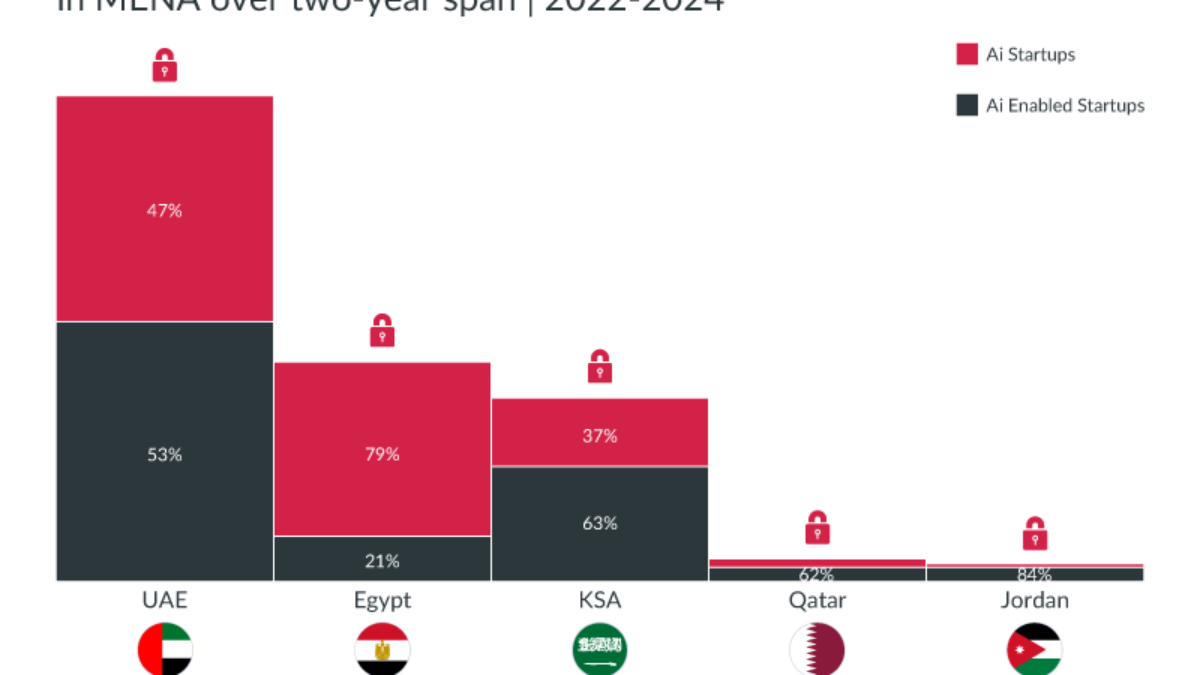
A graph displaying various countries and regions represented by differently colored squares, illustrating AI venture capital funding in the MENA region from 2022 to 2024, with UAE showing the highest percentage. The graph includes data for Egypt, KSA, Qatar, and Jordan.

AI’s Investment in MENA Reality Check

One in five MENA venture deals in 2024 involved AI startups, yet funding tells a different story.

Between 2022 and 2024, 322 AI deals raised $660 million according to Magnitt. In May 2025 alone, despite high-profile visits from U.S. tech executives, AI startups attracted only $25 million across two deals according to Lucidity Insights.

Narrative and capital are decoupled. Sovereign wealth funds announced billions for AI infrastructure. Actual deployment into AI startups remains modest.

Saudi Arabia’s $1 billion GAIA accelerator and UAE’s $6.6 billion investment in OpenAI signal long-term commitment. But early-stage AI ventures struggle to demonstrate revenue traction beyond pilot contracts.

Fintech AI accounts for 26% of AI capital, largely in fraud detection and credit scoring. Enterprise AI software attracts attention but lacks exits to validate valuations.

Investors want proof of concept, not slide decks. AI startups that solve regulated industry problems like Arabic language processing for government services, predictive analytics for supply chains; will capture capital ahead of horizontal platforms.

That’s why every AI startup should build for specific use cases with measurable ROI, target sectors with compliance budgets, and then scale when customers pay, not for technology, but for outcomes.

All that happens while global firehose is fully on; Q1 2025 hit about $66.6B in AI VC according to MAGNiTT, an all-time quarterly peak, with deal counts only nudging up, which means bigger checks and late-stage rounds are back.

In plain terms, money worldwide is chasing AI at scale again. That’s why the contrast with MENA matters: the global tide is rising, but local AI checks remain selective. If you’re a MENA AI founder, the bar is to show revenue and repeatable ROI so you can plug into that global capital wave.
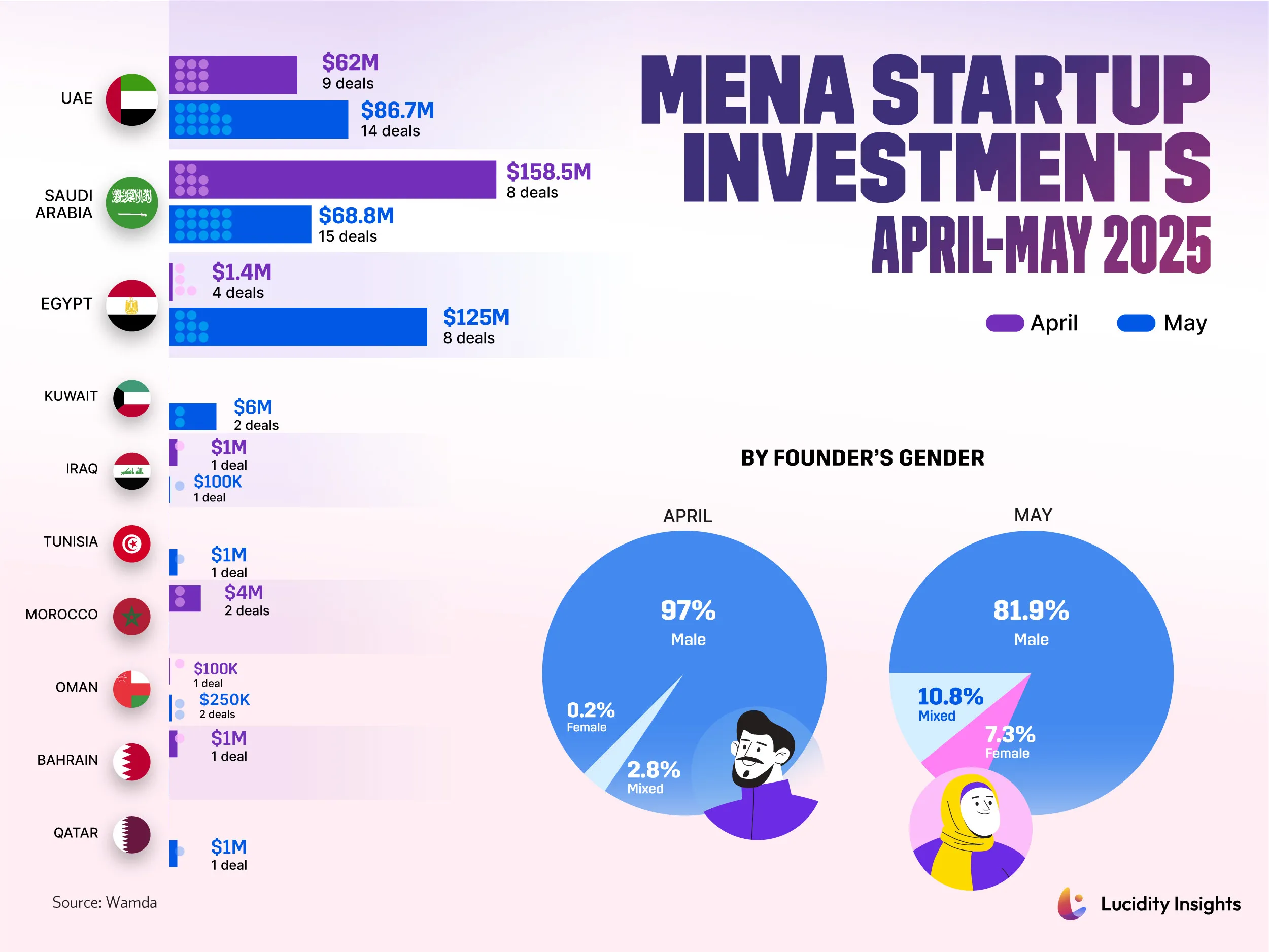
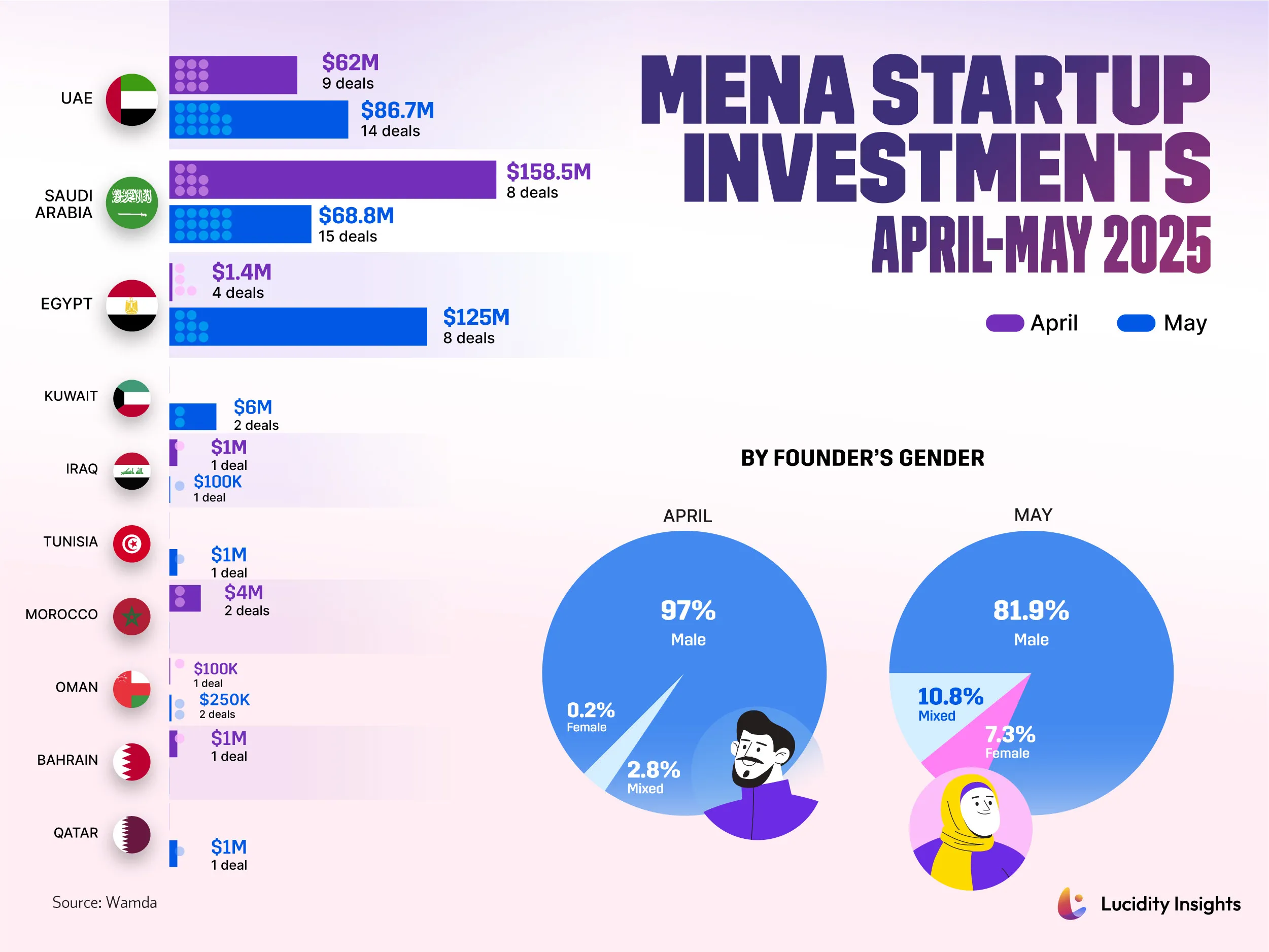
AI funding in MENA is cooling. But at the same time, total startup funding in April–May went up because non-AI rounds (fintech, logistics, marketplace, infra-adjacent plays) carried the month with a few deals plus a lot of small ones representing a 105% month-on-month increase and nearly 300% more than April 2024 according to Lucidity Insights. That’s sector rotation, not a rising AI tide. The money is saying: “We’ll spend where outcomes are clear today.”

References:

Source 1
More Rebrands Than Newbies: Unpacking MENA AI Growth in 2025
https://lucidityinsights.com/infobytes/mena-ai-startups-rebrand-trends-2025

Source 2
FY 2024 Evolution of AI in MENA
https://magnitt.com/research/evolution-of-ai-in-mena-2022-2024-50993

Source 3
Billions in Play: Inside 9 MENA AI Initiatives
https://magnitt.com/news/billions-in-play-inside-the-mena-s-bold-ai-investment-surge-53997

Source 4
Fintech and AI dominate MENA startup funding:
https://www.arabnews.com/node/2616991/business-economy

Source 5
30 Interesting Artificial Intelligence Statistics About the MENA Region
https://digitaldefynd.com/IQ/artificial-intelligence-statistics-about-mena-region/

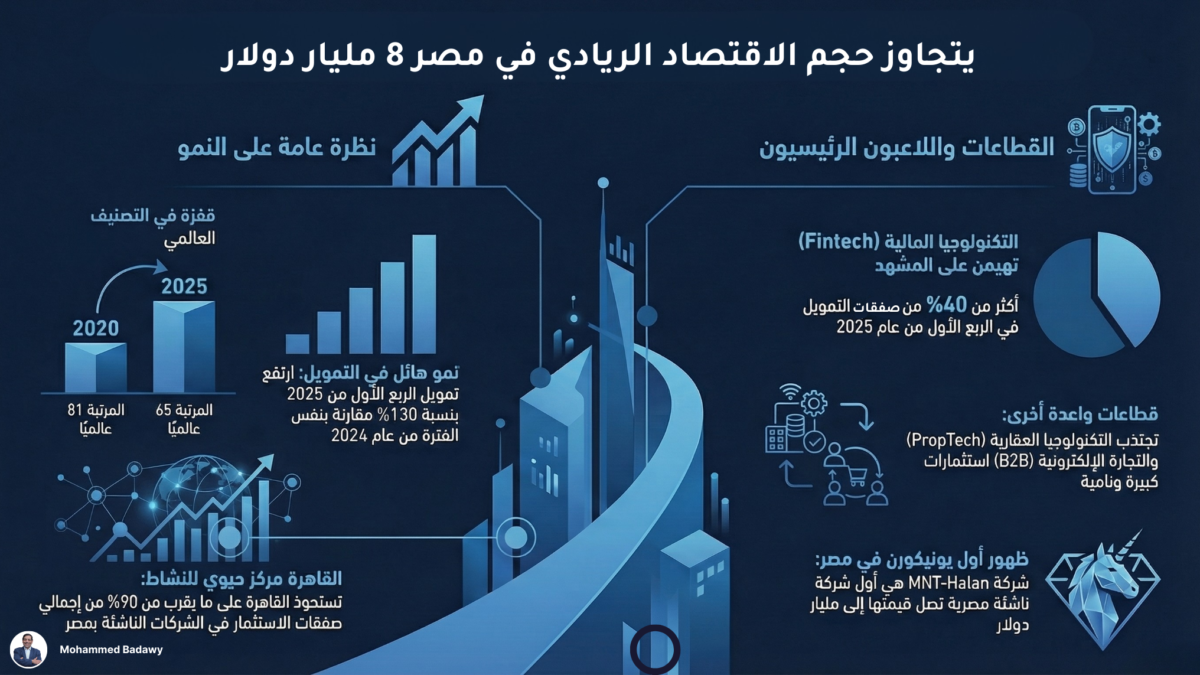
Arabic infographic showing Egypt’s startup economy exceeding $8B, with improved global ranking from 81 (2020) to 65 (2025), Q1 2025 funding up 130% year over year, fintech making up over 40% of deals, Cairo capturing nearly 90% of startup investment, and MNT-Halan highlighted as Egypt’s first unicorn, alongside charts and city skyline visuals.

يتجاوز حجم الاقتصاد الريادي في مصر 8 مليار دولار

من ضغوط الاقتصاد إلى مرحلة “إعادة بناء” حقيقية

على الرغم من استمرار الضغوط الاقتصادية، فإن ما يحدث في مصر اليوم أقرب إلى إعادة بناء المنظومة من جديد، لا مجرد تعافٍ مؤقت. وبرأيي، قد تكون 2026 عامًا مفصليًا: من يبني الآن على أسس صحيحة، سيحصد أفضلية واضحة مع موجة النمو المقبلة.

أين تقف مصر اليوم إقليميًا وعالميًا؟

أصبحت مصر ضمن أكبر ثلاث منظومات تمويل للشركات الناشئة في منطقة الشرق الأوسط وشمال أفريقيا، وتقدمت إلى المركز 65 عالميًا في مؤشر منظومات الشركات الناشئة بعد أن كانت في المركز 81 عام 2020.

كما يتسم المشهد بتمركز شديد في العاصمة:

  • القاهرة تضم نحو 90% من الشركات الناشئة النشطة
  • أكثر من 600 شركة ناشئة (نشطة وقيد التشغيل)
  • ويُقدَّر حجم “الاقتصاد الريادي” بحوالي 8.3 مليارات دولار

هذا التركّز يحمل ميزة واضحة في تجميع رأس المال والمواهب والشبكات في نقطة واحدة، لكنه في الوقت نفسه يكشف فرصة كبيرة لمحافظات أخرى إذا توفرت لها مقومات التمكين.

القطاعات الأكثر تأثيرًا في مصر حاليًا

يمكن تلخيص المشهد في ستة قطاعات تحمل الثقل الأكبر:

  • التقنية المالية FinTech
    لأنها تعالج تحديات الدفع والائتمان والشمول المالي في سوق ضخم واحتياجه واضح.
  • التجارة الإلكترونية E-commerce
    ليس كمتاجر رقمية فقط، بل كبنية تشغيل: سلاسل إمداد، تشغيل، مدفوعات، وتجربة عميل.
  • اللوجستيات والتنقل Logistics & Mobility
    الفرصة هنا لمن يحوّل الفوضى إلى نظام: كفاءة، تتبع، جدولة، وخفض تكلفة.
  • التقنية الصحية HealthTech
    الطلب كبير، والفرص في الخدمات القابلة للتوسع: تشخيص مبكر، متابعة، ورعاية رقمية.
  • التقنية التعليمية EdTech
    سوق واسع، والتحدي الحقيقي هو نموذج ربحي مستدام بعيدًا عن “التمويل المؤقت”.
  • البرمجيات والذكاء الاصطناعي Software & AI
    قد تكون الموجة الأقوى، لكن النجاح ليس في “الذكاء الاصطناعي” كعنوان، بل في منتج يحل مشكلة تشغيلية واضحة ويدخل ميزانيات حقيقية.

التمويل: قفزة كبيرة، ثم تصحيح، ثم عودة تدريجية للتوازن

إذا نظرنا إلى التمويل في صورة كلية:

  • من 2015 إلى 2019: نحو 314 مليون دولار
  • من 2020 حتى اليوم: نحو 2.2 مليار دولار
    أي أن حجم التمويل تضاعف بأكثر من 7 مرات خلال خمس سنوات.

لكن الأهم هو شكل الدورة التمويلية نفسها:

  • 2021 و2022 شهدا طفرة واضحة
  • 2023 و2024 شهدا “تصحيحًا” خصوصًا في الجولات الصغيرة والمتوسطة
  • 2024 كان عامًا انتقاليًا: نحو 300 مليون دولار في 78 صفقة

ثم بدأت مؤشرات التحسن في 2025 بشكل أوضح:
في أول خمسة أشهر فقط، جمعت الشركات الناشئة المصرية نحو 228 مليون دولار في 16 صفقة، بزيادة تقارب 130% مقارنة بالفترة نفسها من 2024، مع صفقات كبيرة مثل:

  • Nawy في قطاع PropTech بنحو 75 مليون دولار
  • وتمويل ديون جديد لـMNT-Halan التي تُعد أول شركة مصرية “يونيكورن”

النمو عاد، لكن بمعايير أكثر صرامة. السوق لم يعد يكافئ “النمو بأي ثمن”.

دعم حكومي: تغييرات تنظيمية قد تعيد رسم قواعد اللعبة

هناك حراك حكومي ملحوظ لدعم الشركات الناشئة، من أبرز ملامحه:

  • تقليل مدة تأسيس الشركة من أكثر من 40 يومًا إلى نحو 11 يومًا
  • إعفاءات ضريبية للشركات التي تقل مبيعاتها عن 20 مليون جنيه
  • إعداد “ميثاق الشركات الناشئة” Startup Charter لتبسيط التعامل مع الجهات الحكومية
  • وفي 2025، تخصيص منطقة حرة تكنولوجية جديدة بمساحة تقارب 9000 متر لدعم شركات الذكاء الاصطناعي والتقنية المالية والبرمجيات

هل هذا كافٍ؟ ليس بعد.
لكن استمرار التنفيذ في هذا الاتجاه يقلل الاحتكاك التشغيلي ويرفع قابلية النمو.

لماذا تبدو 2026 “مختلفة” فعلًا؟

لأنها تبدو سنة فرز حقيقي.
النجاح لن يكون لمن “يجمع جولة تمويل” فقط، بل لمن يستطيع أن:

  • يبني منتجًا يُباع ويستمر
  • يضبط اقتصاديات الوحدة مبكرًا
  • يضع مسار توسع إقليمي واضح
  • يبني حوكمة وامتثالًا من البداية
  • يصنع ميزة تنافسية يصعب نسخها

وبالنسبة للمستثمرين، فالتقييمات أصبحت أكثر واقعية، والسوق بدأ يكافئ الجودة والصلابة التشغيلية بدل الضجيج.

مصر كبوابة للمنطقة: فرصة كبيرة لكنها ليست تلقائية

إذا استمر مسار الإصلاح، ومع استمرار نمو التمويل بالوتيرة الحالية، يمكن لمصر أن تظل:

  • بوابة رئيسية لمنطقة الشرق الأوسط وشمال أفريقيا
  • سوقًا ضخمًا للاختبار والتحقق من المنتج
  • مصدرًا مهمًا للمواهب التقنية

ومع الوقت قد نشهد “يونيكورن” جديدة في قطاعات مثل: PropTech، والتجارة بين الشركات B2B، والتقنية المالية.

السؤال الحقيقي

المشهد يُعاد بناؤه… والفرصة واضحة.

من سيستغل هذه اللحظة لبناء شركات تستطيع أن تنمو وتربح فعليًا على مستوى الإقليم؟

المراجع:

[1] WTO (World Trade Organization) – Egypt | ICT Services Export Promotion (PDF).

https://www.wto.org/english/tratop_e/ts4d_e/case_studies_e/egypt.pdf

[2] StartupBlink – Egypt Startup Ecosystem (Rankings, Startups, Insights).

https://www.startupblink.com/startup-ecosystem/egypt

[3] StartupBlink – Cairo Startup Ecosystem (Rankings, Startups, Insights).

https://www.startupblink.com/startup-ecosystem/cairo-eg

[4] EnterpriseAM – Egypt leads startup activity in Africa in 2024 (Jan 12, 2025).

https://enterpriseam.com/egypt/2025/01/12/egypt-leads-startup-activity-in-africa-in-2024/

[5] Ministry of Planning, Economic Development and International Cooperation (Egypt) – Egyptian Startups Attract $228M (Jan–May 2025) (Jun 1, 2025).

https://www.mped.gov.eg/singlenews?id=6324&lang=en

[6] Wamda – Nawy secures $75 million in equity, debt to fuel MENA expansion (May 12, 2025).

https://www.wamda.com/2025/05/nawy-secures-75-million-equity-debt-fuel-mena-expansion

[7] Reuters – Egypt’s MNT-Halan says Turkish acquisition… (Jul 31, 2024).

https://www.reuters.com/business/finance/egypts-mnt-halan-says-turkish-acquisition-help-expand-consumer-credit-factoring-2024-07-31

[8] The Egyptian Entrepreneurship Sector Diagnostics Report 2023 By Entlaq Holding

https://entlaq.com/reports/2

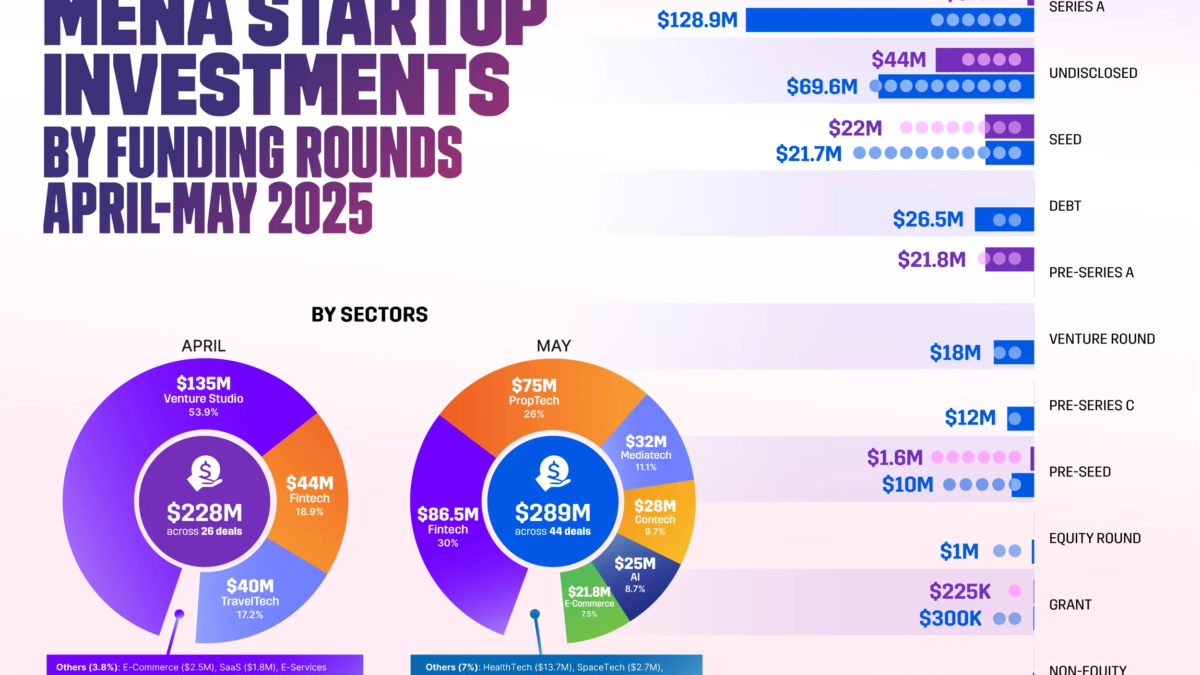
MENA Startup Investments by Funding Rounds April-May 2025 - Blog

Early-Stage Deal Flow Strengthens

While mega-deals dominate headlines, early-stage activity is accelerating.

In Q2 2025, early-stage startups recorded 67 deals; across April–May 2025 according to Wamda, MENA startups raised about US$517.4 million in 70 deals across all stages, according to Lucidity Insights.

Investors are backing pipelines over proven scale. That signals confidence in founder quality and market opportunity.​

Saudi Arabia’s early-stage programs: Monsha’at, GAIA, accelerators backed by SVC cumulative impact: 54 SVC-backed funds have invested in over 800 startups and SMEs to date according to Magnitt, reflecting sustained early-stage support.

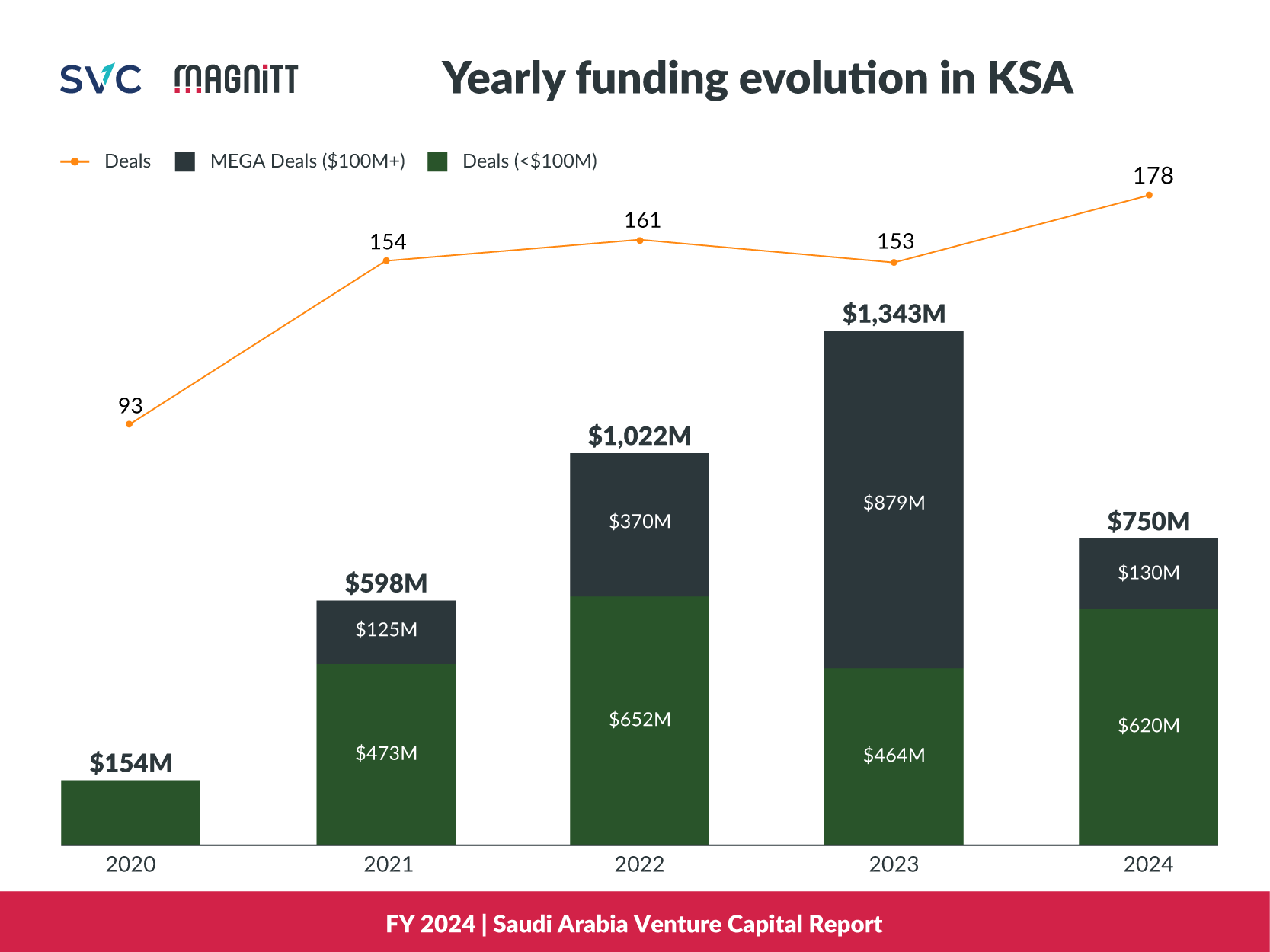
According to Magnitt, Saudi Arabia’s venture market hit a funding peak in 2023 at 1.343 billion dollars, then fell to 750 million dollars in 2024, a drop of about 44 percent. Deal count moved the opposite way, rising to 178 in 2024, the highest in the series. The mix flipped toward smaller checks. In 2024 mega rounds contributed 130 million dollars while rounds under 100 million delivered 620 million dollars, about 83 percent of the total. Compare that with 2023 when mega rounds were 879 million dollars and dominated the year.

That means more deals with fewer headline dollars point to valuation discipline and capital spreading across many seeds and Series A rounds. It suggests a wider pipeline forming now with potential conversion into larger growth rounds over the next couple of years.


Early-stage funding in UAE climbed modestly in 2025, while Egypt topped May (with large rounds lifting totals), indicating resilient early-stage participation despite macro volatility.

The ecosystem is building depth, not just unicorns. More founders, more angel investors, more repeat entrepreneurs create compounding effects over time.​

Early-stage capital availability determines the next cohort of growth-stage companies. MENA’s deal count suggests a healthy pipeline is forming.​

Investors are spreading bets across sectors; fintech, healthtech, logistics, SaaS, climate tech, rather than concentrating in one vertical.​

Founders should prioritize capital efficiency and verifiable traction before Series A, aligning milestones with the more disciplined deployment environment.

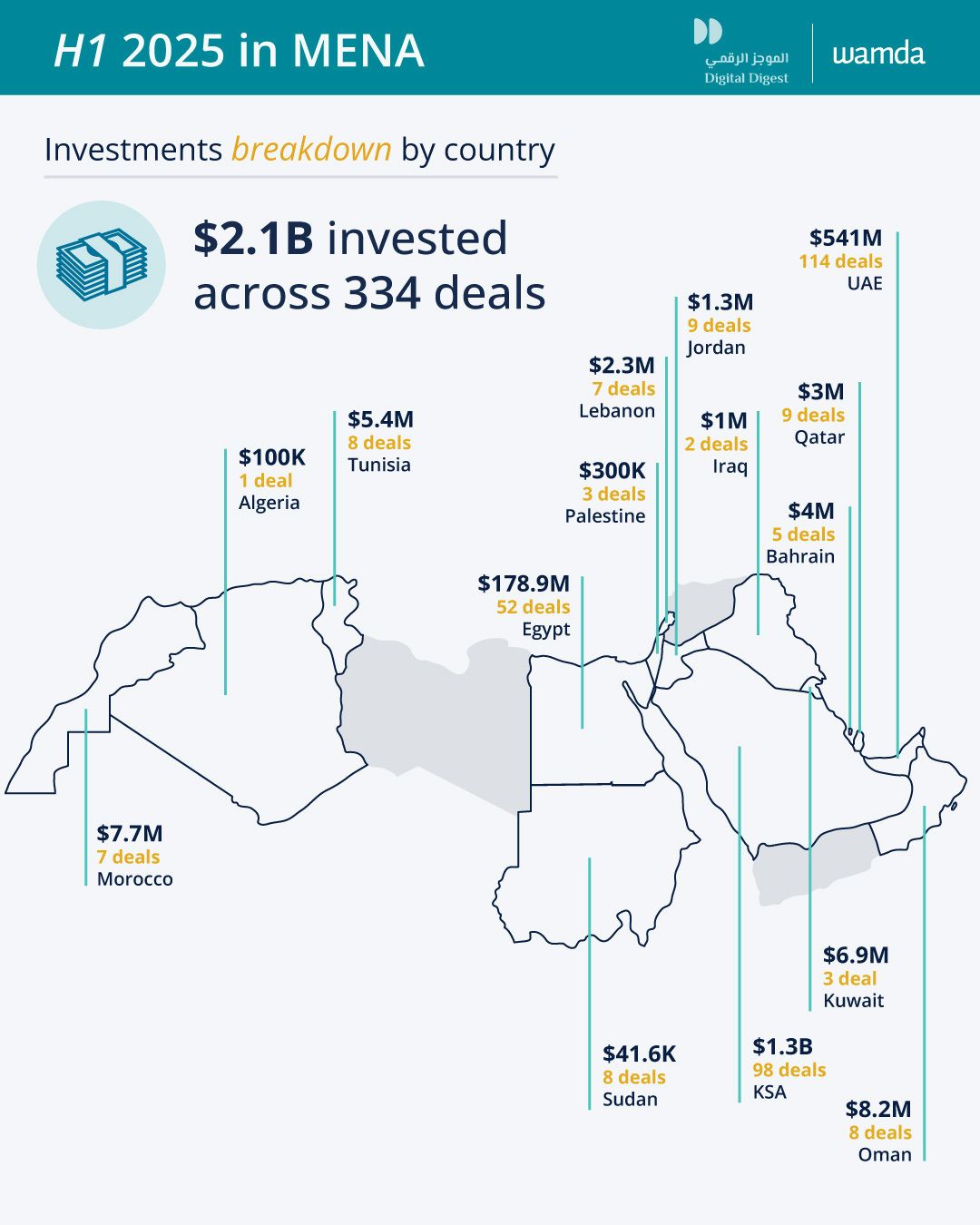
Wamda’s Investment Breakdown by country graph shows that in H1 2025 MENA startups raised 2.1 billion across 334 deals. Saudi Arabia captured 1.3 billion about 62 percent and the UAE 541 million about 26 percent with Egypt at 179 million about 9 percent. By deal count the UAE led with 114 followed by Saudi Arabia with 98 and Egypt with 52 which together made up 79 percent of all deals. Most other markets recorded single digit millions, showing a long tail.

Sources:

Source 1

MENA Startup Funding Hits US$2.1 Billion in H1 2025:
https://fintechnews.ae/27046/fintech/mena-startup-funding-h1-2025

Source 2

MENA Startup Funding: $517M in Apr–May 2025:
https://lucidityinsights.com/infobytes/mena-startup-funding-trends-apr-may-25

Source 3

MENA Startup Funding – In-Depth Analysis & Forecast (Apr–May 2025):
https://lucidityinsights.com/infobytes/mena-startup-funding-apr-may-25

Source 4

Saudi Venture Capital Co. invests $1bn, strengthening the VC landscape (54 funds; 800+ startups/SMEs):
https://www.arabnews.com/node/2589135/business-economy

Source 5

MENA Startups Raise $289M in May as Egypt Leads:
https://fintechnews.ae/26475/fintech/mena-startup-funding-may-2025

Source 6

MENA VC Funding Hits $1.5B in H1 2025, Strongest First Half Since 2022:
https://magnitt.com/news/mena-vc-funding-hits-1-5b-in-h1-2025-strongest-first-half-since-2022-54003

Investment Breakdown by Sector - Blog

Embedded Finance Becomes the Default Path to Scale

Embedded finance is no longer experimental in MENA. It has become the dominant financing model for growth. MAGNiTT data shows fintech attracted $596 million across 93 deals in H1 2025, roughly tripling year-on-year while global fintech funding contracted.​

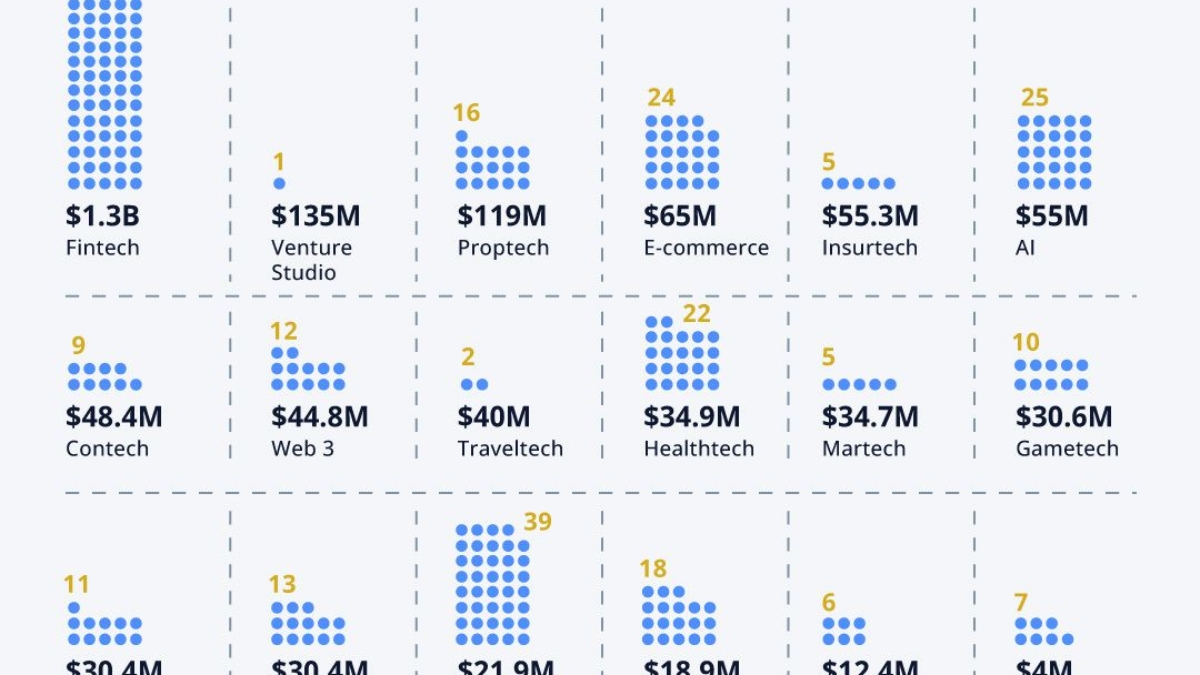
Fintech’s $1.3 billion share of the region’s $2.1 billion total H1 2025 investment, according to Wamda, underscores its centrality to capital deployment across all market stages.

The Saudi Central Bank’s Open Banking framework and the UAE’s Payment Services Regulations now operate as core infrastructure for growth. Builders who align early with these rules move faster, face fewer surprises, and unlock partnerships that last.​

Recent rounds confirm the direction. Tabby raised $160 million in H1 2025, anchoring late-stage fintech growth. Tamara secured a $2.4 billion debt facility, demonstrating that mature platforms can access non-dilutive capital at scale.​

The shift is broader than payments. B2B compliance and operational software gained traction as regulatory mandates expanded; governments became direct buyers of digital solutions, pulling startups into mission-critical workflows.​

Vertical fintech wins when compliance becomes product strength. Buy-now-pay-later platforms that integrate regional payment rails and regulatory requirements (like Sharia-compliance structures in some jurisdictions) build customer trust in ways pure consumer software alone cannot match. That trust compounds into retention and better unit economics.​

Capital follows certainty. In MENA that certainty now exists in payments, lending, and digital wallets. Choose embedded finance over standalone apps. Treat regulatory alignment as core IP. Expand when local banks shift from rival to partner. This is how durable fintech franchises are built in the region today.

Sources:

Source 1

H1 2025 MENA VC Premium Report
https://magnitt.com/research/H1-2025-MENA-VC-Premium-Report-50999

Source 2

MAGNiTT’s H1 2025 MENA FinTech Report
https://www.linkedin.com/posts/philipbahoshy_fintech-mena-venturecapital-activity-7371769504273514496-BkGB

Source 3

Saudi Arabia leads MENA VC rankings with $860m in H1
https://www.arabnews.com/node/2608176/business-economy

Source 4

MENA Startup Funding Hits US$2.1 Billion in H1 2025
https://fintechnews.ae/27046/fintech/mena-startup-funding-h1-2025/

Source 5

MENA VC Funding Hits $1.5B in H1 2025, Strongest First Half Since 2022
https://magnitt.com/news/mena-vc-funding-hits-1-5b-in-h1-2025-strongest-first-half-since-2022-54003